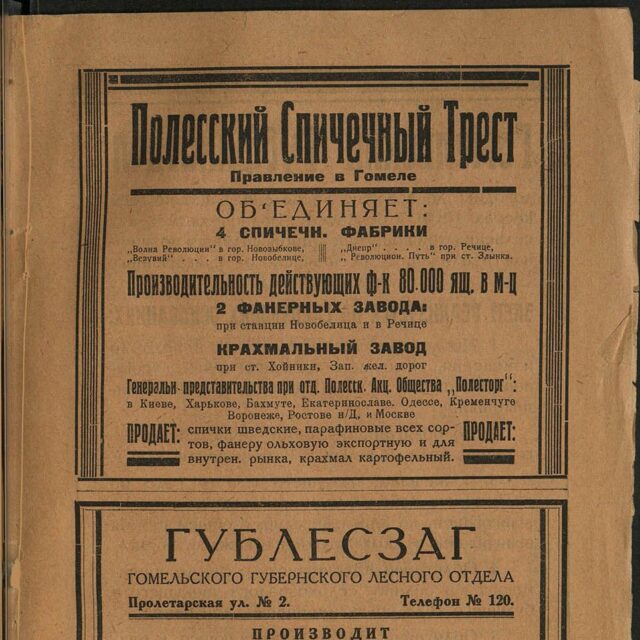
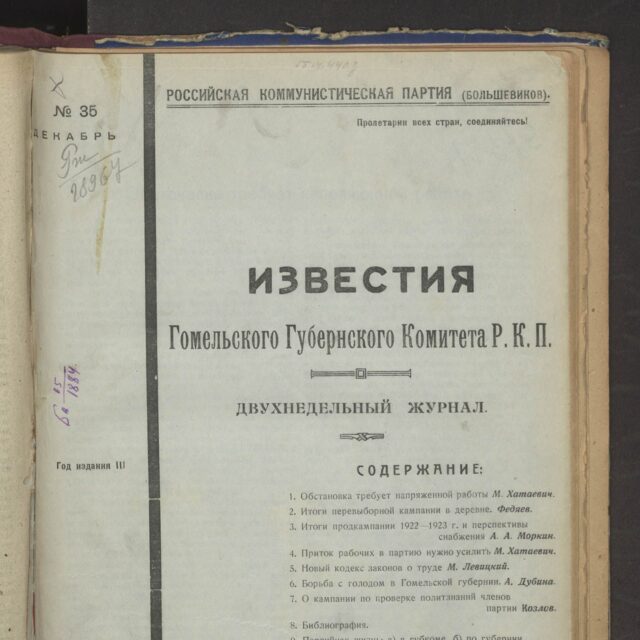
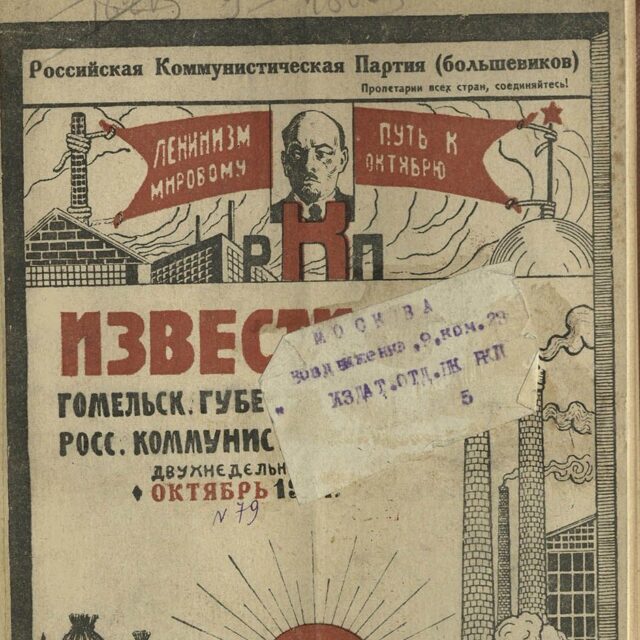
Historical Context and Source Note: This study is based on primary records and statistical surveys from three foundational archival collections of the 1920s: the party journal "Izvestiya of the Gomel Provincial Committee of the RCP(b)" (1920–1925), the administrative "Bulletin of the Department of Governance of the Gomel Provincial Executive Committee" (1923–1924), and the analytical "Bulletin of the Gomel Provincial Statistical Bureau" (1923–1926). The source base incorporates the seminal polemical treatise by publicist Ilya Shkapa "Through the Khutor to the Commune", protocols of provincial land conferences, decrees of the Council of People's Commissars of the USSR (Sovnarkom), records of the All-Union Resettlement Committee, and statistical investigations into rural surplus labor in Polesia. The publication explores a little-known chapter in the history of Belarus: the peasantry's desperate struggle to break free from chronic agrarian overpopulation during the New Economic Policy (NEP), the fierce contest over individual farmsteads (khutors), and the subsequent state-organized migration of Polesian families to Siberia, the Altai, and the Far East.
Table of Contents
- 1. The Agrarian Impasse of Polesia: 1.2 Desyatinas per Capita and Soil Depletion
- 2. "Land Reform Fever": The Failure of the Soviet Settlement Commune
- 3. The Ideological Clash: Zaitsev's "Robinsons" vs. Ilya Shkapa's "Khutors"
- 4. The Physical Limit of Land and Sovnarkom's Verdict: From "Nowhere to Resettle" to 300,000 Migrants
- 5. Echelons to Siberia: Benefits, Property Qualifications, and the Geography of Migration
- 6. The Genealogical Echo: Why Belarusian Surnames Resonate Across the Urals
- Sources and References
1. The Agrarian Impasse of Polesia: 1.2 Desyatinas per Capita and Soil Depletion
By the early 1920s, the eastern and southern regions of Belarus had reached extreme demographic and agrarian saturation. World War I, the Russian Civil War, economic devastation, the influx of returning refugees, and natural population growth against the rigid framework of the traditional peasant commune culminated in an acute land shortage crisis.
The Decree on Land and the abolition of noble estates provided only brief psychological relief. The available land fund of former gentry estates (including the vast holdings of Princes Paskevich in Gomel and Dobrush counties) proved critically insufficient for hundreds of thousands of landless and smallholder peasants.
The 1924–1925 surveys conducted by the provincial land department across Gomel county revealed an alarming picture:
- Dobrush volost: approximately 23,000 desyatinas of arable land were available for 45,000 rural inhabitants — less than half a desyatina per person.
- Krasnobudskaya volost: population density stood at 71 people per square verst. An average peasant household held only 7 desyatinas of land, amounting to merely 1.25 desyatinas of arable and meadow land per capita ("per eater").
According to comprehensive surveys by the Provincial Statistical Bureau, the average land endowment of a peasant household across the province did not exceed 9.36 desyatinas (including infertile terrain, bogs, and brushland). In smallholder strata (cultivating under 2 desyatinas of cropland), congestion reached extraordinary levels: up to 5.2 individuals, including 2.8 able-bodied adult workers, were crammed onto a single desyatina of arable land. Peasants were physically crowded upon one another, and the soil could not sustain minimal biological subsistence.
Because of severe land scarcity, peasant households fragmented continuously among maturing sons. In Krasnobudskaya volost alone, 775 households lacked draft horses entirely, while 240 households owned no cows. Working livestock was severely inadequate: one draft horse served an average of 5.5 desyatinas of cropland.
Soil depletion reached critical proportions. During the grain requisitioning (prodrazvyorstka) years, striving to secure minimal subsistence, peasants regressed from three-field crop rotation to archaic two-field rotation. As district agronomists noted in 1925, mineral fertilizers were entirely unaffordable for destitute peasants, and the local livestock manure was sufficient to fertilize only 1,784 desyatinas annually. Consequently, an individual peasant strip received organic fertilizer only once every 45.5 years. Crop yields declined relentlessly, and the countryside remained perpetually on the brink of hunger.
In the official "Bulletin of the Department of Governance of the Gomel Provincial Executive Committee" (issue No. 3, April 1923), a stark confession of total administrative impasse was recorded:
"All data available to us indisputably demonstrate that land hunger prevails across the province. The People's Commissariat of Agriculture (Narkomzem) instructs us to adopt measures to eliminate this hunger. Here, naturally, the question of eviction and resettlement arises. Yet, upon examining this issue and inspecting the actual state of affairs, it turns out that we presently have nowhere to resettle people. Thus, we are forced to focus on expanding our land fund through land reclamation... However, for the successful execution of reclamation works in the province, we lack the necessary financial resources..."
The authorities recognized their entrapment: no unallocated lands existed within the province, the central government had not yet authorized inter-provincial migration quotas in 1923, and funds for draining Polesian swamps were non-existent in the regional budget.
2. "Land Reform Fever": The Failure of the Soviet Settlement Commune
With the advent of NEP, a veritable "land reform fever" erupted across the Belarusian countryside. Refusing to accept chronic poverty, peasant assemblies besieged district land offices demanding immediate demarcation and parceling of arable tracts.
Bolshevik leadership initially sought a solution exclusively in collective and group land reorganization, fearing the resurgence of strong individual proprietors. An official report of the Gomel Provincial Party Committee (issue 1924-078) noted with concern:
"Land reform fever shakes the village relentlessly... Land reorganization proceeds spontaneously; we do not control the course of land reform — land reform controls us, and we trail behind the unstoppable force of peasant demands."
Simultaneously, land reorganization sparked acute class confrontation inside the villages. In a confidential administrative survey of the Provincial Executive Committee (issue 1924-001, pp. 19–20), the conflict was laid bare:
"Regarding land reform in the countryside, a sharp struggle between two strata of the peasantry is plainly visible. The kulaks actively resist land reorganization and strive by every means to obstruct its execution; the poor peasants, who have a vital stake in it, push forcefully for land demarcation but cannot afford the required advance survey payments. The stance of the village soviets must be firm and decisive: as long as a resolution by the majority of the population exists on this matter, it is binding upon all, and the wealthy element must be the first to supply the required funds, even if they voted against it..."
Between 1920 and 1924, land reform in Gomel province encompassed a staggering 734,732 desyatinas (over 55% of all agricultural land). However, the actual outcome proved deeply contradictory:
- Only 9,194 desyatinas (a mere 1.25% of the total) were allocated to collective farms (communes and artels) — peasants emphatically resisted collectivization;
- Only 22,831 desyatinas (3.1%) were allocated to individual farmsteads (khutors);
- The overwhelming majority — 696,707 desyatinas (94.8%) — was partitioned into so-called "posyolki" (new rural settlements, numbering over 1,200, typically comprising 23–31 households each).
Soviet planners assumed that relocating villagers into compact settlements would resolve agrarian tension. Yet reality shattered these administrative blueprints. In practice, the Soviet posyolok remained the exact same archaic commune, retaining all its inherent flaws:
- Persistent strip farming (cherepolositsa): each proprietor's holding remained scattered in narrow ribbons across multiple fields, with boundary ridges (mezhi) wasting up to 7% of arable acreage;
- Distance from fields (dalnozemelye): the distance from home to remote plots ranged from 1.5 to 4 versts;
- Immense waste of labor: peasants expended 40% to 60% of their working hours and energy on empty transit, equipment wear, and cartage — traveling up to 1,898 versts per agricultural season;
- Direct economic loss: economic calculations revealed that each desyatina in a settlement generated an annual net loss of 9 rubles 55 kopecks compared to a consolidated khutor farmstead.
Instead of land organization, delegates at the XII Provincial Party Conference lamented what they termed "land disorganization" (zemlerasstroystvo).
3. The Ideological Clash: Zaitsev's "Robinsons" vs. Ilya Shkapa's "Khutors"
Between 1923 and 1925, an intense ideological clash unfolded in the provincial press over how to revive regional agriculture.
In 1923, the head of the provincial land department D. Ya. Zaitsev (issue 1923-047_048) articulated the dogmatic stance, vehemently condemning Stolypin's legacy and private farmsteads:
"These miniature khutor Robinsons, perched on their tiny land islands, were of great interest only to Tsarist Russia... The maxim 'divide the commune into khutors and rule' was swiftly implemented... Can Soviet power — the power of workers and peasants — pursue such a policy in land reform? No, it cannot. Soviet power has reversed this process entirely toward the formation of settlement and collective forms of land tenure."
By 1925, however, the economic failure of the posyolki was so evident that prominent writer and publicist Ilya Shkapa (subsequently Maxim Gorky's literary secretary and editor of Nashi Dostizheniya) intervened. Across two issues of the provincial journal (No. 15 and No. 16, 1925), he published a provocative, detailed study titled: "Through the Khutor to the Commune (On the Place of Khutors in the Land Reform of Gomel Province)".

Shkapa openly declared that the previous five years of Soviet land reform constituted "five years of wasted effort, five years of illiterate fragmentation of territory."
Marshaling extensive agronomic statistics, Shkapa demonstrated:
- A consolidated khutor eliminates boundaries, distant travel, and strip farming, saving 50% of peasant labor and reclaiming up to 15% of arable land;
- Only on a khutor can a farmer transition from three-field rotation to intensive multi-field cultivation with clover, vetch, root crops, and stable-fed dairy cattle;
- Basic agronomic improvements on a khutor double crop yields;
- The khutor does not breed capitalism; it establishes the foundation for socialism: Citing Workers' and Peasants' Inspectorate (RKI) investigations of the Kostyukovka (Gomel county) and Lakomaya Buda (Novozybkov county) khutors, Shkapa showed that khutor farmers joined marketing, drainage, and machinery cooperatives at three times the rate of communal peasants (39% vs. 13.1%) and were the first to collectively purchase tractors ("steel horses").
Shkapa's conclusion was groundbreaking for its era: the path to genuine cooperative farming and rural prosperity under NEP lay not through impoverished communal settlements, but through productive individual farmsteads.
4. The Physical Limit of Land and Sovnarkom's Verdict: From "Nowhere to Resettle" to 300,000 Migrants
Yet even the most radical consolidation into khutors faced an insurmountable physical barrier: an absolute lack of available land. Even if the entire regional territory had been subdivided into optimal farmsteads, sustaining the burgeoning population of Polesia was mathematically impossible.
The turning point arrived in early 1924. The pressure of rural society upon the district land departments reached its zenith. A formal decree of the Presidium of the Gomel Provincial Executive Committee dated February 1924 (issue 1924-002, p. 11, item 9) documented a profound shift in state policy:
"Establishing the extraordinary urge of the peasant population to resettle in other provinces, and taking into account the directive of the People's Commissariat of Agriculture (NKZ) on resettlement, instruct comrade Zaitsev to draft a plan of resettlement and present it within one week to the Presidium of the Provincial Executive Committee for a definitive decision on this matter."
Within less than twelve months, the state's stance underwent a complete reversal: from the hopeless assertion of spring 1923 that *"we presently have nowhere to resettle people"*, the province transitioned to emergency preparation for the mass evacuation of surplus agrarian population. The very same head of the land department, D. Ya. Zaitsev, who had excoriated "khutor Robinsons", was now forced to formulate an organized migration scheme within seven days.
The crisis soon escalated to the all-Union level. In early 1926, agrarian overpopulation in Gomel province became the subject of high-level government deliberation in Moscow. As documented in Gomel Provincial Statistical Bureau surveys and an official report in "Izvestiya TsIK SSSR" (No. 8, January 10, 1926), the Council of People's Commissars of the USSR (Sovnarkom) formally recognized the rural surplus population of the province at 26% and concluded that up to 300,000 individuals urgently needed to be resettled outside the region. Sovnarkom instructed Narkomzem USSR to factor Gomel's acute distress into long-term state resettlement schemes.
A specialized rural council survey conducted by the Provincial Statistical Bureau in late 1925 and early 1926 registered over 32,500 adult able-bodied workers in the countryside who constituted absolute surplus labor, lacking any employment or subsistence. The primary epicenters of rural joblessness were Gomel county (11,351 individuals) and Rechitsa county (8,912 individuals), where 76% of unemployed peasants survived solely by fragmenting meager domestic rations, and 3% were reduced to mendicancy.
The impetus originated from below. Rather than waiting for bureaucratic machinery, village communes took initiative and dispatched trusted delegates — khodoki (scouts/envoys) — to the east.
In the spring of 1925 alone, approximately 30 khodoki departed from Krasnobudskaya volost to inspect available land funds in eastern provinces of the RSFSR. These scouts traveled thousands of versts, surveyed virgin plots in Siberia and the Altai, evaluated soil fertility, drinking water sources, and railway proximity, and returned to village assemblies with comprehensive reports.
In May 1925, a decree of the III Congress of Soviets of the USSR conferred supreme state status upon the resettlement movement. The All-Union Resettlement Committee (VPC) was established under the Central Executive Committee of the USSR to systematically relieve agrarian pressure in western republics.
5. Echelons to Siberia: Benefits, Property Qualifications, and the Geography of Migration
The scale of Belarusian peasant demand for Siberian lands was extraordinary. In 1925–1926, peasants from Belarus submitted over 77,600 official applications for resettlement. The vast majority — more than 60,000 families — requested relocation specifically to Siberia.
However, state financial and logistical resources were limited. For 1926, the actual relocation quota granted to Belarus was capped at approximately 15,000 individuals (9,000 destined for Siberia and 6,000 for the Far East).
State selection criteria were stringent. Dispelling the misconception that only the rural lumpenproletariat migrated, Soviet authorities deliberately prioritized resilient, productive households:
- Property qualification: a prospective family had to possess starting capital of at least 500–800 rubles in cash, livestock, and implements (the VTsIK decree of July 25, 1922 specifically restricted privileges for households unable to clear and cultivate new land);
- Labor qualification: a family was required to have at least 2.5–3 adult able-bodied workers capable of breaking virgin Siberian sod and erecting farmsteads;
- State benefits: migrants received discounted rail fares (or free transport under state resettlement certificates), exemption from the unified agricultural tax for 3 to 5 years, duty-free transit of farm machinery and household goods, and interest-free loans for timber and seed purchases.
Primary destinations of Gomel peasant migrants:
- Minusinsk and Khakass districts (Yenisei province / Krasnoyarsk territory): the fertile Minusinsk Basin, noted for its favorable microclimate, attracted thousands of Polesian families, who established entirely Belarusian villages and settlements;
- Altai province (Slavgorod and Barnaul districts): the Kulunda steppes and Altai foothills were settled by emigrants from Rechitsa, Gomel, and Novozybkov counties;
- Siberian Territory (Novonikolayevsk / Novosibirsk, Omsk, Tomsk): agricultural tracts along the Trans-Siberian Railway;
- Far Eastern Territory (DVK — Amur Region and Primorye): Far Eastern allotments reached 15–20 desyatinas per capita, an unfathomable wealth compared to Gomel's 1.25 desyatinas;
- Salsk Steppes (North Caucasus Territory): virgin grasslands of the Don and Kuban basins.
From Gomel and Novobelitsa railway stations, train echelons of freight wagons (teplushki) departed steadily, carrying entire extended families toward a new destiny.
6. Генеалогическое эхо: Почему белорусские фамилии звучат за Уралом
Для современного исследователя семейной истории и генеалогии Беларуси анализ событий 1920–1926 годов дает ключ к разгадке важнейшей исторической тайны.
Нередко при изучении родословных исследователи сталкиваются с необъяснимым на первый взгляд фактом: крестьянская семья веками непрерывно фиксируется в ревизских сказках и метрических книгах сел Гомельского, Речицкого или Рогачевского уездов, однако в 1930–1940-х годах ветви рода внезапно появляются в списках жителей Красноярского края, Иркутской области, Алтая или Кузбасса.
Традиционно такие миграции автоматически списывают либо на столыпинскую реформу (1906–1914), либо на сталинское раскулачивание и спецпоселения 1930-х годов. Однако архивные документы убедительно доказывают существование мощнейшего третьего миграционного потока — добровольно-планового переселения эпохи нэпа (1924–1927 гг.).
Статистические материалы Гомельского губстатбюро раскрывают еще одну фундаментальную деталь: советское переселение эпохи нэпа опиралось на прочный дореволюционный фундамент. По данным Челябинского переселенческого пункта, только за один мирный 1913 год из уездов будущей Гомельской губернии за Урал выехало свыше 2 000 человек. А по данным земских подворных переписей за 16 предвоенных лет (1896–1911 гг.), Могилевская и Черниговская губернии, территории которых вошли в состав Гомельщины, занимали 2-е и 4-е места во всей Российской империи по относительной доле переселенцев (9,4 и 8,9 выехавших на каждые 100 душ населения), уступая лишь Полтавской губернии.
Таким образом, отправляясь на восток в 1924–1926 годах, крестьяне ехали не в неизвестность — они направлялись в сибирские волости и поселки, где уже обжились их старшие братья, дядья и односельчане первой столыпинской волны. Они везли с собой в Сибирь полесские традиции льноводства и животноводства, своеобразный говор и родовые фамилии.
Ирония судьбы заключалась в том, что, уйдя от колхозов и малоземелья на тысячи верст на восток, они всего через четыре года — на рубеже 1929–1930 годов — вновь встретили на сибирских просторах каток сплошной принудительной коллективизации, от которой так отчаянно пытались спастись.
Sources and References
- Izvestiya of the Gomel Provincial Committee of the RCP(b):
- Shkapa, I. Through the Khutor to the Commune (On the Place of Khutors in the Land Reform of Gomel Province) // Izvestiya of the Gomel Provincial Committee of the RCP(b). 1925. No. 15, pp. 44–50; No. 16, pp. 59–66.
- Zaitsev, D. Ya. Land Reform in Gomel Province // Izvestiya of the Gomel Provincial Committee of the RCP(b). 1923. No. 47–48, pp. 20–25.
- Korovikov, G. Agriculture in Krasnobudskaya Volost // Izvestiya of the Gomel Provincial Committee of the RCP(b). 1925. No. 13, pp. 69–71.
- Materials for the XII Gomel Provincial Conference of the RCP(b). Report of the Provincial Committee // Izvestiya of the Gomel Provincial Committee of the RCP(b). 1924. No. 80, pp. 36–42.
- On the Status of Land Reform in the Province: Reports and Summaries // Izvestiya of the Gomel Provincial Committee of the RCP(b). 1924. No. 78, pp. 13–16, 56–60.
- Bulletin of the Department of Governance of the Gomel Provincial Executive Committee:
- Report of the Presidium of the Gomel Provincial Executive Committee on Land Hunger and Resettlement Impasse // Bulletin of the Department of Governance of the Gomel Provincial Executive Committee. 1923. No. 3, p. 3.
- On the Struggle Between Peasant Strata Over Land Reform and Advance Survey Fees // Bulletin of the Gomel Provincial Executive Committee. 1924. No. 1, pp. 19–20.
- Decree of the Presidium of the Gomel Provincial Executive Committee on the Extraordinary Urge to Resettle and Instructions to Comrade Zaitsev // Bulletin of the Gomel Provincial Executive Committee. 1924. No. 2, p. 11.
- Resolution on the Volost Partitioning of Gomel and Rogachev Counties // Bulletin of the Department of Governance of the Gomel Provincial Executive Committee. 1923. No. 4, p. 6.
- Bulletin of the Gomel Provincial Statistical Bureau:
- Lopushansky, F. On the Issue of Surplus Labor in the Countryside of Gomel Region // Bulletin of the Gomel Provincial Statistical Bureau. 1926. No. 4, pp. 63–68.
- National Composition and Mother Tongue of the Population of Gomel Province According to the 1920 Census // Bulletin of the Gomel Provincial Statistical Bureau. 1926. No. 5–6, pp. 3, 115–116.
- The Impact of Land Reform on Peasant Household Stratification by Livestock and Crop Acreage // Bulletin of the Gomel Provincial Statistical Bureau. 1926. No. 5–6, pp. 147–151.
- Population of Cities and Urban-Type Settlements According to the 1917, 1920, and 1923 Censuses // Bulletin of the Gomel Provincial Statistical Bureau. 1923. No. 1, pp. 14–22.
- Decree of the Council of People's Commissars of the USSR on Overpopulation in Gomel Province and Resettlement Planning // Izvestiya TsIK SSSR. 1926. January 10. No. 8.
- Kindeyev, K. Ya. Land Reform Issues in Connection with Agricultural Intensification. — Moscow: Novaya Derevnya, 1924.
- Muravsky, I. The State of Agriculture in Gomel Province. — Gomel: Gomel Provincial Land Department, 1924.
- Resolution of the III Congress of Soviets of the USSR on Resettlement and Land Reserves of May 20, 1925 // Collection of Laws and Orders of the Workers' and Peasants' Government of the USSR. 1925. No. 35, Art. 249.
- Decree of the All-Russian Central Executive Committee (VTsIK) of July 25, 1922 "On Privileges for Resettlers and Migrants".
- Grinevich, V. M. Resettlement of Peasants of the Belarusian SSR to Eastern Regions of the USSR (1924–1928) // Bulletin of BSU. Сер. 3. 1982. No. 1.