Historical and Source-Critical Note: This study by Vladimir N. Piatnitski, Candidate of Agricultural Sciences, was published in 1981 in the interdepartmental collection “Problems of Water Resources” by BelNIINTI. The paper provides a fundamental methodological critique of the traditional nitrogen-based balance method used across Soviet pedology to estimate peat depletion in drained bogs. The author demonstrates that crediting crop root and stubble residues as “compensation” for peat mineralization is fundamentally flawed, identifying them instead as a “return apparatus” within an internal closed nitrogen loop. A refined quantitative equation integrating biological nitrogen fixation and non-productive losses is formulated.
Original Source: Piatnitski, V. N. Balance Method for Accounting Organic Matter Loss in Peat During Agricultural Crop Cultivation // Problems of Water Resources: collected scientific works / BelNIINTI. — Minsk, 1981. — Pp. 127–130. Original repository entry: Electronic Library of BSTU.
The rate of organic matter (OM) mineralization in drained peat-bog soils is largely determined by agricultural management practices. The annual rate of organic matter mineralization and depletion reported by various researchers ranges from 1 to 16 metric tons per hectare.
Principles of the Balance Method and Critique of Crop Residue Compensation
Numerous methods exist for determining organic matter depletion. In our investigations, we analyzed the balance method [1], which quantifies the expenditure and revenue components of peat mineralization.
Organic matter depletion is conventionally calculated from the economically valuable crop yield harvested and removed from the field (grain, straw, roots, and tubers) combined with non-productive losses (drainage discharge, wind erosion, gaseous emissions, etc.). Crop root and post-harvest stubble residues, along with litterfall, have traditionally been entered into the balance equation as a revenue (replenishment) item and subtracted from gross organic matter losses.
To standardize balance items across different plant organs, all accounting is mediated through nitrogen equivalents. A mandatory methodological prerequisite of the method is the complete exclusion of synthetic nitrogen fertilizers, ensuring that all synthesized biomass derives strictly from native soil (peat) nitrogen reserves.
“We argue that incorporating compensation from plant residues (roots, stubble, litterfall) into balance calculations is fundamentally erroneous.”
Crop Residues as a “Return Mechanism” Rather Than Net Compensation
A detailed audit of balance components demonstrates that total organic matter synthesized by crops on peat soils comprises harvested output, root biomass, post-harvest residue, and litterfall. The latter components remain in situ or are incorporated into the plough layer during tillage.
In unfertilized peat soils, the nitrogen contained in these plant residues originates entirely from mineralized native peat organic matter (and residues from previous seasons). When residues decompose, this nitrogen is returned to the soil profile, merely closing a “minor” internal cycling loop of nitrogen and organic matter. Plant residues thus function as a “return apparatus” [2] rather than an external compensatory input.
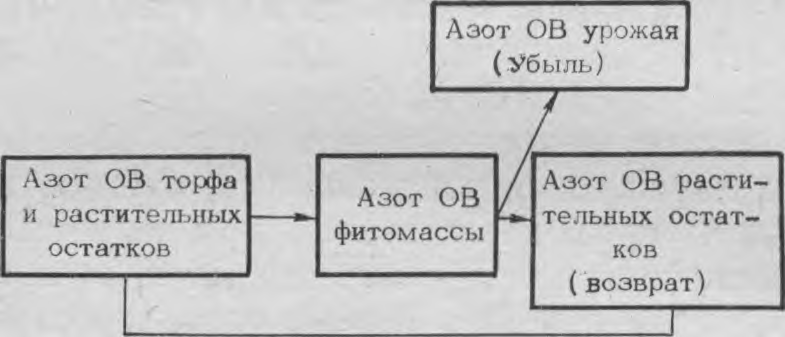
Consequently, from a strict nitrogen balance perspective, there is no justification for subtracting crop residues as compensation: peat nitrogen is simply cycled back through plant biomass.
Although the gross mass of plant residues typically exceeds the mass of mineralized peat consumed in their formation (owing to differing C:N ratios and lower nitrogen percentage in fresh biomass), newly incorporated organic material undergoes rapid breakdown. Within 3–5 years following ploughing, root and stubble tissues are virtually completely decomposed [3].
Within an established crop rotation, the soil profile maintains a steady-state pool of fresh organic matter derived from residues of the preceding 3–5 seasons. Taking differing degrees of humification into account, this corresponds to approximately 1.5–2.5 times the mean annual residue input (e.g., 100% of current season inputs, plus 50%, 25%, and 0% remaining from prior years).
Under long-term agricultural exploitation of peatlands, this labile pool represents a negligible fraction of cumulative peat depletion over decades and can be safely omitted from long-term loss estimations.
Overlooked Revenue Items: Biological Nitrogen Fixation and Atmospheric Inputs
Conversely, traditional balance assessments systematically ignore several authentic external revenue streams:
- Nitrogen fixed by free-living diazotrophic soil bacteria and rhizobia in legume symbioses;
- Atmospheric wet and dry deposition in precipitation (~5 kg N/ha annually);
- Nitrogen imported with sowing seeds (3–10 kg N/ha);
- Immigration via soil macrofauna and aeolian dust deposition (difficult to quantify and quantitatively secondary).
Symbiotic nitrogen fixation varies dynamically with hydrothermal conditions. On mineral soils, forage legumes obtain up to two-thirds of their total nitrogen requirement from atmospheric fixation (the Hopkins coefficient). A corresponding proportion of fixed nitrogen is incorporated into belowground residues:
- Second-year clover-timothy grass mixtures: ~60 kg N/ha annually;
- Fodder lupine: ~40 kg N/ha annually;
- Pea-oat and vetch-oat mixtures: ~20 kg N/ha annually.
Non-symbiotic fixation by free-living diazotrophs also contributes substantially: multi-year records from Rothamsted Experimental Station indicate free-living bacteria accumulate 60–100 kg N/ha in soil, of which 30–60 kg/ha is directly assimilated by crops [3].
Refined Mathematical Formulation of Peat Depletion
Accounting for true closed-loop recycling and discounting illusory residue compensation, actual peat organic matter depletion under unfertilized arable cropping is expressed by:
y — actual peat organic matter loss, metric tons/ha;
C — nitrogen exported in harvested crop yield (grain, straw, forage, tubers), tons/ha;
H — non-productive nitrogen losses (drainage outflow, surface runoff, wind erosion, denitrification/gaseous emission, mechanical soil removal on harvested root crops — 15–20+ kg/ha), tons/ha;
K — genuine nitrogen replenishment from seed material, biological diazotrophs, and precipitation, tons/ha;
P — total nitrogen concentration in the peat soil profile, %.
Where mineral nitrogen fertilizers are applied, net replenishment is adjusted by incorporating the empirical fertilizer recovery coefficient.
Agronomic Implications and the Primacy of Perennial Grassland
Rigorous balance calculations without nitrogen fertilizers demonstrate that at equivalent biological yield levels, altering the arable crop mix alone does not meaningfully curb peat mineralization rates. Effective conservation depends on structural management.
Perennial grasses offer distinct ecological advantages over annual row crops. Their root systems senesce predominantly in late autumn when microbial breakdown is inhibited by sub-zero soil temperatures. Furthermore, dense superficial sod desiccates the top 5–10 cm active layer during summer, suppressing aerobic microbial activity and preserving organic carbon.
However, terminating grassland through ploughing triggers explosive mineralization of accumulated organic matter. The shorter the grassland phase in a rotation, the weaker the soil-conserving effect. Continuous, permanent grassland management represents the only effective strategy for minimizing mineralization and preserving the organic profile of drained Polesian peatlands.
References
- Gordiichuk, A. S. Influence of Agricultural Utilization and Moisture on the Depletion of Deep Peatlands in the Ukrainian Polesia // Soil Science (Pochvovedenie). — 1978. — No. 11.
- Titlyanova, A. A. Exchange Processes of Nitrogen and Ash Elements in the Soil-Plant Subsystem // On the Soils of Siberia. — Novosibirsk: Nauka, 1978.
- Stankov, N. Z. Root System of Field Crops. — Moscow: Kolos, 1964.