Historical and Source-Critical Note: This study was published in the flagship pedological journal of the Soviet Academy of Sciences, “Pochvovedenie” (Soviet Soil Science, Moscow: Nauka, 1990, No. 11, pp. 127–132). Authored by BelNIIMiVH scientists Vladimir N. Piatnitski (Cand. Sci. Agr.), L. B. Avdeev, and G. I. Lavrenchuk, the paper summarizes a five-year investigation (1979–1983) integrating laboratory incubation with precision field stationary trials at the Polesian Land Reclamation Experimental Station (Luninets). The authors rigorously differentiated ammonium and nitrate nitrogen dynamics across soil moisture and temperature gradients under bare fallow, barley, and timothy grass.
Original Source: Piatnitski, V. N., Avdeev, L. B., Lavrenchuk, G. I. Impact of Hydrothermal Conditions on the Mineral Nitrogen Content in Peat Soil // Pochvovedenie (Soviet Soil Science). — 1990. — No. 11. — Pp. 127–132.
Drained peat soils possess substantial native reserves of nitrogen, released continuously via the mineralization of peat organic matter. However, accurate forecasting, monitoring, and engineering control of soil nitrogen regimes have remained difficult due to conflicting empirical models. In agricultural practice, drained peatlands frequently exhibit either acute nitrogen deficiencies or excessive nitrate accumulation, leading to yield reductions and elevated nitrate levels in forage and food crops.
Laboratory and Field Experimental Methodology
Soil moisture is among the decisive factors controlling organic matter mineralization and mineral nitrogen pool dynamics. Under field conditions, topsoil moisture fluctuates dynamically between field capacity and wilting point. During 1979–1983, coordinated laboratory incubation and field trials were conducted to establish mathematical response functions relating peat soil moisture to ammonium ($text{NH}_4text{–N}$), nitrate ($text{NO}_3text{–N}$), and total mineral nitrogen.
Trials utilized a woody-sedge-hypnum peat soil with a decomposition degree of ~35%, total nitrogen content of 2.45%, $text{P}_2text{O}_5$ of 0.46%, and $text{K}_2text{O}$ of 0.13% (dry basis) with 14% ash content. Basal phosphorus-potassium fertilizers were applied ($text{P}60text{–}100$, $text{K}200text{–}240$); no synthetic nitrogen was applied.
- Laboratory Experiments: Soil samples with contrasting baseline mineral nitrogen levels were adjusted to moisture regimes of 20, 30–70, and 80% (volumetric) and incubated at temperatures of 8.12–24.28 °C over 84 days, with six analytical cycles conducted at 14-day intervals.
- Stationary Field Trials (POMS, Luninets): Six distinct moisture treatments were maintained across plots of timothy grass, spring barley, and bare fallow using mobile polyethylene rain shelters combined with scheduled sprinkler irrigation (8–10 events per season). Soil profiles (0–10, 10–20, and 20–30 cm) were analyzed colorimetrically: nitrates with disulfophenolic acid and ammonium with Nessler reagent.
Mineral Nitrogen Dynamics in the Plough Horizon
Five-year trial observations revealed that both vegetation cover and soil moisture fundamentally alter the balance of mobile nitrogen forms (Table 1).
| Soil Moisture (%) | Bare Fallow (No Plants) | Under Spring Barley | Under Timothy Grass | ||||||
|---|---|---|---|---|---|---|---|---|---|
| $text{NH}_4text{–N}$ | $text{NO}_3text{–N}$ | Total | $text{NH}_4text{–N}$ | $text{NO}_3text{–N}$ | Total | $text{NH}_4text{–N}$ | $text{NO}_3text{–N}$ | Total | |
| 34 | 85 | 105 | 190 | 41 | 42 | 83 | 44 | 34 | 78 |
| 40 | 75 | 150 | 225 | 51 | 42 | 93 | 58 | 31 | 89 |
| 50 | 79 | 188 | 267 | 58 | 68 | 126 | 60 | 22 | 82 |
| 55 | 85 | 184 | 269 | 54 | 47 | 101 | 65 | 25 | 90 |
| 60 | 82 | 116 | 198 | 69 | 41 | 110 | 74 | 30 | 104 |
| 70 | 131 | 45 | 176 | 94 | 41 | 135 | 101 | 38 | 139 |
Table 1. Mineral nitrogen content (kg/ha) in the topsoil (0–30 cm) of peat soil as a function of moisture level and vegetative cover (means of 1979–1980).
Mineralization Dynamics: Laboratory and Field Synthesis
Laboratory incubations established that nitrate nitrogen accumulation and total mineral nitrogen follow a clear parabolic response curve ($eta = 0.85$), reaching a pronounced optimum at approximately 50% volumetric moisture (~60% of total pore capacity).
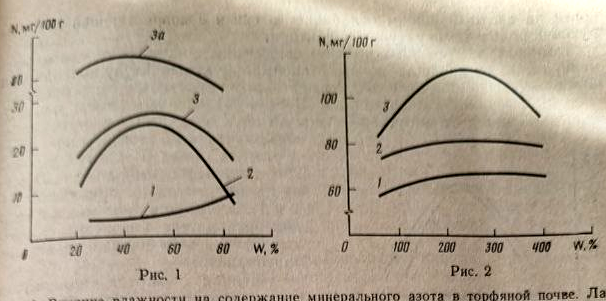
Under waterlogged conditions ($W = 70%$), nitrate generation plummeted from 188 to 45 kg/ha due to acute oxygen starvation and suppression of nitrifying microorganisms. Concurrently, ammonium nitrogen accumulated sharply, rising from 79 to 131 kg/ha.
Five-year stationary field trials fully validated the parabolic response model:
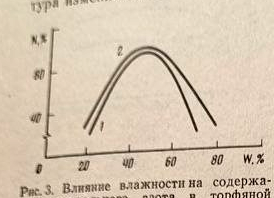
Maximum mobile nitrogen accumulation under fallow (267–269 kg/ha) occurred at 50–55% moisture. Temperature acts as a critical gating factor: chilling below 10 °C suppresses nitrification regardless of moisture availability, whereas warming to 20–24 °C accelerates mineralization severalfold.
Plant Uptake and Biological Self-Regulation
Contrasting bare fallow plots with barley and timothy stands quantified crop rhizosphere uptake and biological buffering:
- At optimal moisture (50–55%), active crop uptake depleted mineral nitrogen by 168 kg/ha (63% reduction), driven predominantly by nitrate assimilation ($text{NO}_3text{–N}$ depleted by 145 kg/ha, six times greater than ammonium depletion).
- Under soil saturation ($W = 70%$), nitrate uptake ceased almost entirely (dropping to 6 kg/ha, or 12%), and total uptake fell to 40 kg/ha. Plants shifted their physiological uptake exclusively to ammonium.
- Under moisture stress ($W = 34%$), total crop extraction reached 109 kg/ha (58%).
Downward vertical leaching of mineral nitrogen beyond the plough zone was negligible with a stable groundwater table of 0.7–1.0 m: upward capillary flux neutralized leaching, conserving nitrogen within the upper 30 cm rhizosphere.
Conclusions
- Stationary experiments established parabolic response relationships ($eta = 0.85$) between peat soil moisture and mineral nitrogen accumulation, with an optimum at 50–55% volumetric moisture (~60% of field capacity).
- Soil thermal regimes serve as a master regulator: below 10 °C, peat mineralization remains subdued across all moisture levels, whereas warming to 20–24 °C drives rapid nitrification.
- Cultivated crops (barley and timothy) exert powerful biological self-regulation, assimilating up to 168 kg N/ha under optimal moisture. Under waterlogging, nitrification ceases and plants switch to ammonium nutrition.
- Dual-action hydraulic control of peatlands via sluice-gate regulation represents a direct engineering mechanism for modulating peat mineralization rates and preventing excessive nitrate contamination of soils and agricultural yields.
References
- Mishustin, E. N. Microorganisms and Agricultural Productivity. — Moscow: Nauka, 1972. — 343 p.
- Skoropanov, S. G. Land Reclamation and the Problem of Organic Matter // Zemledelie. — 1981. — No. 7. — Pp. 18–20.
- Kudeyarov, V. N. The Nitrogen Cycle in Soil and Fertilizer Efficiency. — Moscow: Nauka, 1989. — 216 p.
- Skrynnikova, I. N. Hydrological Regime of Peat Soils and Its Regulation // Pochvovedenie. — 1977. — No. 5.
- Shebeko, V. F. Hydrological Regime of Drained Territories. — Minsk: Uradzhay, 1970. — 298 p.