Historical and Source-Critical Note: This study by BelNIIMiVH researchers Vladimir N. Piatnitski (Cand. Sci. Agr.) and L. B. Avdeev was published in 1984 in the academic journal “Proceedings of the Academy of Sciences of the BSSR. Agricultural Sciences Series” (No. 4, pp. 39–43; manuscript received October 20, 1983). Pioneering the application of multivariate regression modeling on the ES-1020 mainframe computer in Belarusian agricultural science, the authors analyzed 16-year continuous observational datasets across three distinct districts of Polesia (Luninets, Ivatsevichi, and Oktyabrsky). The study established the “law of technological determination”, proving that advanced agronomy elevates weather into the dominant regulatory driver explaining up to 94% of yield variance.
Original Source: Piatnitski, U. M., Audzeyew, L. B. Weather and Barley Yield on Peat Soils // Proceedings of the Academy of Sciences of the BSSR. Series of Agricultural Sciences. — 1984. — No. 4. — Pp. 39–43. Authorized translation from the Belarusian original.
Barley yield on drained peat soils is substantially governed by prevailing weather conditions. Across humid temperate zones, interannual yield variations are driven primarily by shifts in ambient temperature, atmospheric humidity, and solar radiation, which are closely coupled to precipitation patterns [1].
Problem Formulation and Empirical Research Base
The objective of this research was to quantitatively determine the functional dependence of cereal grain yield on weather conditions and provide an objective appraisal of their fractional contribution to yield volatility. Mathematical analyses utilized linear and curvilinear regression (hyperbolic and quadratic parabolic models).
The empirical foundation encompassed multi-year crop yields and meteorological observations across three contrasting sectors of Belarusian Polesia:
- Luninets District (Brest Region) — stationary microplot and field trials at the Polesian Land Reclamation Experimental Station (POMS), alongside 7-year and 16-year commercial production field records from its experimental farm;
- Ivatsevichi District (Brest Region) — Kossovo State Variety Testing Station on deep peat soils over 16 consecutive seasons (cultivars Alsa and Mami);
- Oktyabrsky District (Gomel Region) — Oktyabrsky variety testing station in Eastern Polesia over a 16-year period.
Management practices were categorized into three distinct technological tiers:
- Optimal Technology (mean yield 47 cwt/ha, POMS microfield trials with dual-action water regulation and balanced mineral nutrition);
- Advanced Technology (37–41 cwt/ha, variety testing stations and progressive field trials);
- Standard Farm Practice (32 cwt/ha, commercial production fields over 16 years).
The vegetative cycle was segmented into 38 discrete calendar intervals. The resulting multidimensional data matrices were processed on the ES-1020 mainframe computer in Minsk.
Thermal and Atmospheric Humidity Impacts
Correlation analysis revealed significant parabolic relationships between grain yield and mean diurnal air temperature during April–May and May–June in Oktyabrsky District ($eta = 0.54 – 0.64$). The coefficient of determination indicates that 30–40% of interannual yield variance in this sector stemmed from spring temperature fluctuations.
In Ivatsevichi District, up to 58% of yield variation was governed by relative air humidity: persistent overcast dampness consistently depressed cereal output.
Precipitation as an Integrative Climatological Indicator
The closest functional relationship was established between grain yield and cumulative precipitation, which acts as an integrative proxy for insolation, cloud cover, and peat thermal regimes.
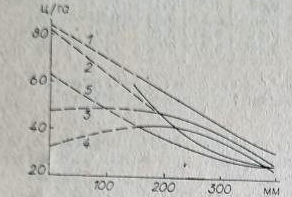
Because biological response surfaces in agrocenoses typically follow parabolic functions [3], yield-precipitation relationships were modeled using quadratic parabolic equations:
| Site / Management Level | Regression Equation | $eta$ | $pm S_{yx}$ (cwt/ha) | $d_{yx}$ (%) |
|---|---|---|---|---|
| Period: April — August 10 | ||||
| 1. Microplots (Optimal) | $y = 91.5 – 0.2130x + 1545 cdot 10^{-7}x^2$ | 0.969 | 2.7 | 94% |
| 2. Ivatsevichi (Advanced) | $y = 113.3 – 0.4436x + 5705 cdot 10^{-7}x^2$ | 0.758 | 8.3 | 57% |
| 3. Oktyabrsky (Advanced) | $y = 47.5 + 0.0658x – 2890 cdot 10^{-7}x^2$ | 0.799 | 6.6 | 64% |
| 4. POMS Field Trials | $y = 70.8 – 0.1445x + 1214 cdot 10^{-7}x^2$ | 0.763 | 5.5 | 58% |
| 5. POMS Production (7 yrs) | $y = 29.4 + 0.1535x – 4108 cdot 10^{-7}x^2$ | 0.756 | 4.3 | 57% |
| 6. POMS Production (16 yrs) | $y = 68.3 – 0.2104x + 2767 cdot 10^{-7}x^2$ | 0.525 | 6.9 | 28% |
Table 2. Parabolic regression models relating barley grain yield ($y$, cwt/ha) to cumulative rainfall ($x$, mm). $eta$ — correlation ratio; $pm S_{yx}$ — standard error of estimate; $d_{yx}$ — coefficient of determination (weather fractional contribution).
The Law of Technological Determination
Cross-comparison of coefficients of determination establishes a fundamental theoretical principle:
- Under optimal management (Equation 1), the relationship with precipitation approaches a deterministic function ($eta = 0.969$), with climatic variables explaining 94% of grain yield variance.
- Under advanced technology (Equations 2–5), precipitation accounts for 57–64% of variance.
- Under standard farm practice (Equation 6), weather factors explain merely 28% of interannual yield fluctuations!
“If only 25–30% of yield variance is driven by precipitation, the remaining 70–75% is dictated by uncalibrated manageable inputs: drainage norms, fertilizer balances, and timing of tillage.”
This exposes an agronomic paradox: substandard farming practices mask true climatic impacts. Farm managers routinely attribute crop shortfalls to adverse weather, whereas nearly three-quarters of losses originate from operational and managerial deficits. Conversely, high agricultural discipline removes soil and nutrient constraints, allowing varietal genetic potential to express itself and leaving macroclimate as the primary natural regulator.
Conclusions
- Barley yield volatility on drained peatlands is governed by a complex of weather variables, with cumulative precipitation serving as the most effective integrative indicator.
- The influence of weather on yield increases in direct proportion to technological discipline and agronomic culture. Conversely, lower average productivity reflects an overriding share of preventable management errors.
- Systematic optimization of drainage and soil fertility on peatlands guarantees a baseline yield of not less than 35 cwt/ha of barley grain. Deviations below calculated potential response surfaces (Fig. 3, curve 1) serve as an objective metric for evaluating farm operational performance.
References
- Piatnitski, V. N., Avdeev, L. B., Kokhnyuk, P. Ya., Sudas, A. S. // Land Reclamation of Waterlogged Lands. — Minsk: Uradzhay, 1982. — Vol. 30. — Pp. 88–97.
- Dospekhov, B. A. Methodology of Field Experimentation. — Moscow: Kolos, 1973. — 335 p.
- Goryshina, T. K. Plant Ecology. — Moscow: Vysshaya Shkola, 1979. — 367 p.