Following Leon Trotsky's walkout from the Brest-Litovsk negotiations on February 10, 1918, declaring "neither war nor peace", the German High Command decided to immediately resume hostilities on the Eastern Front — a rapid offensive known as Unternehmen "Faustschlag" (Operation Punch Stroke).
By February 21, German and Austro-Hungarian forces had advanced:
-
over 100–150 kilometers into the territory of the former Russian Empire;
-
capturing Dvinsk (Daugavpils), Luninets, and Borisov;
-
moving toward Minsk virtually unopposed.
The Capture of Minsk
By the evening of February 21, vanguard units of the German 10th Army (Army Group Eichhorn) entered Minsk.
 Translation of the German official report:
German Troops in Minsk. Berlin, February 21, evening. (Official.) The offensive in the East continues. German troops entered Minsk. There is no news from other theaters of war.
This concise military dispatch highlights several key aspects:
-
the precise date of entry — the evening of February 21, 1918;
-
confirmation that the operation was part of a coordinated general strategic advance rather than an isolated action;
-
the German operational perspective: Minsk was not treated as an independent political focal point, but as an essential logistical link in a broader chain of advance.
From a military standpoint, Minsk held paramount strategic value:
-
as a critical railway hub linking the frontline, the Petrograd axis, and Ukraine;
-
as the principal administrative and logistical center of the Western Front region;
-
as a powerful strategic lever for exerting direct diplomatic pressure on the Bolshevik government in Brest-Litovsk.
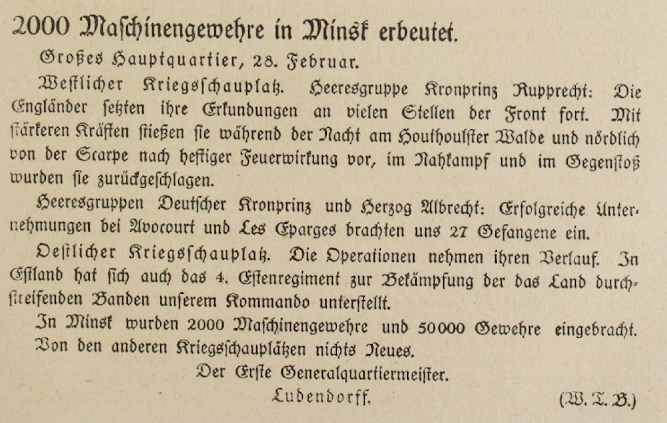 Source: Deutsche Digitale Bibliothek
The German communique of February 28 underscores the extraordinary volume of military supplies captured in Minsk: 2,000 machine guns and 50,000 rifles. These figures illustrate not merely the surrender of a city, but the comprehensive collapse of Bolshevik military organization on the former Western Front. Russian forces evacuated Minsk so precipitously that vast military depots — designed to supply entire army groups — were abandoned almost without resistance. In 1918, Minsk functioned as one of the most critical logistical hubs of the Russian army, housing strategic arsenals, mobilization stockpiles, and junction lines connecting the front with central Russian regions. For German commanders, these massive trophies demonstrated both the tactical success of the February campaign and the total dissolution of the former imperial military apparatus. The communique reflects both military realities and political intent: Germany demonstrated undisputed dominance across the Eastern Front, dictating peace terms at will.

Following the resumption of the German offensive in February 1918, the primary objective of Field Marshal Hermann von Eichhorn's 10th Army was a rapid eastward advance relying on existing railway networks. The central role was assigned to the III Reserve Corps, tasked with advancing through Smorgon to Molodechno and subsequently utilizing the local railway corridor toward Minsk.
As early as February 19, the corps vanguard — mobile cavalry, cyclist, and ski detachments — reached Molodechno unopposed, securing the railway station along with intact rolling stock, locomotives, and equipment. German engineers swiftly restored the line, enabling a "railway offensive" (Eisenbahnoffensive) wherein troops and heavy artillery were transported forward rapidly by rail, avoiding prolonged foot marches.
The sudden German advance created acute disorganization among Bolshevik authorities, prompting the 10th Army command to widen its operational goals. Securing the major railway junction of Minsk became the top priority. Advanced elements of the 14th Landwehr Division reached the city on February 21, followed shortly by the main body of forces. German units interacted with the Polish formations of General Jozef Dowbor-Musnicki (1st Polish Corps), who acted as observers and handed over accumulated war booty and depots.
Within Minsk itself, thousands of Russian military personnel — including the former headquarters staff of the Western Front — remained passive, witnessing the transition of power without offering resistance. The German command declared the city under military control and instituted a military governorship.

Subsequent operational orders directed forces toward Orsha and Bobruisk to sever eastern railway corridors and eliminate any possibility of a Bolshevik counter-maneuver. However, because sections of the railway between Borisov and Orsha had been demolished, elements of the III Reserve Corps took an alternative route via Zhlobin and Mogilev. Repairing track damage along the march, German units occupied Zhlobin on February 27 and Rogachev the following day. Meanwhile, northern detachments advanced via Polotsk and Drissa along the Western Dvina River.
By February 28, Minsk had become the central operational hub of the German military presence in Belarus. To the east, German strongpoints lined the railway arteries, while rear administrative areas were placed under military governance. The Polish Corps, which had entered the city center shortly before the German arrival, declined to participate in further operations and withdrew peacefully.
Simultaneously, diplomatic developments accelerated: Germany anticipated an imminent formal peace treaty. Both sides agreed that all hostilities would cease on March 3. By that date, German spearheads had reached Mogilev, approached the western perimeter of Orsha, and established a demarcation line assigning Orsha to German administration.
Thus concluded the swift February campaign, enabling Germany in a matter of days to occupy the key strongholds and logistics bases of the former Russian Western Front — Smorgon, Molodechno, Minsk, Borisov, Polotsk, Zhlobin, and Mogilev — securing decisive diplomatic leverage that culminated in the signing of the Treaty of Brest-Litovsk on March 3, 1918.