Contents
- Introduction: Personal Dimension and an Era of Transformation
- The 1945 Threshold: Devastated Drainage Networks and Postwar Recovery
- Institutional Architecture: Minvodkhoz BSSR, Glavpolesievodstroy, and Regional Trusts
- Engineering Design: Belgiprovodkhoz Institute and River Basin Regulation
- The Scientific Vanguard: BelNIIMiVH and Academician S. G. Skoropanov’s School
- Field Research Stations: The Polesian Experimental Station and Peatland Outposts
- Industrial Mechanization: Wide-Track Tractors, Ditchers, and Laser Tile Trenchers
- The May 1966 Plenum: The Battle for Polesia and the Rise of Polder Systems
- The Ecological Dilemma: Peat Subsidence, Dust Storms, and Two-Way Regulation
- The Chernobyl Frontier (1986): Emergency Hydraulic Countermeasures and Radiation Defense
- Historical Lessons and Archival Heritage (BGANTD)
- Sources and References
Introduction: Personal Dimension and an Era of Transformation
For the author of this study, the history of postwar Belarusian land reclamation is far from an abstract academic inquiry; it is deeply rooted in living family memory. My parents belonged to the generation of technical specialists whose daily professional dedication created the grand water management and land improvement complex of the republic. My father, Vladimir Nikolayevich Piatnitski, Candidate of Agricultural Sciences, upon graduating from the Belarusian Agricultural Academy in Gorki, devoted himself to scientific research at the Belarusian Research Institute of Melioration and Water Management (BelNIIMiVH), serving in the Department of Peatland Reclamation and Agro-melioration under the mentorship of the eminent academician Stepan Gordeyevich Skoropanov. In the same decades, my mother worked as an engineer at the State Design Institute “Belgiprovodkhoz” — the specialized planning organization on whose drafting boards the polders, main arterial canals, and reservoirs of Belarusian Polesia were designed and engineered.
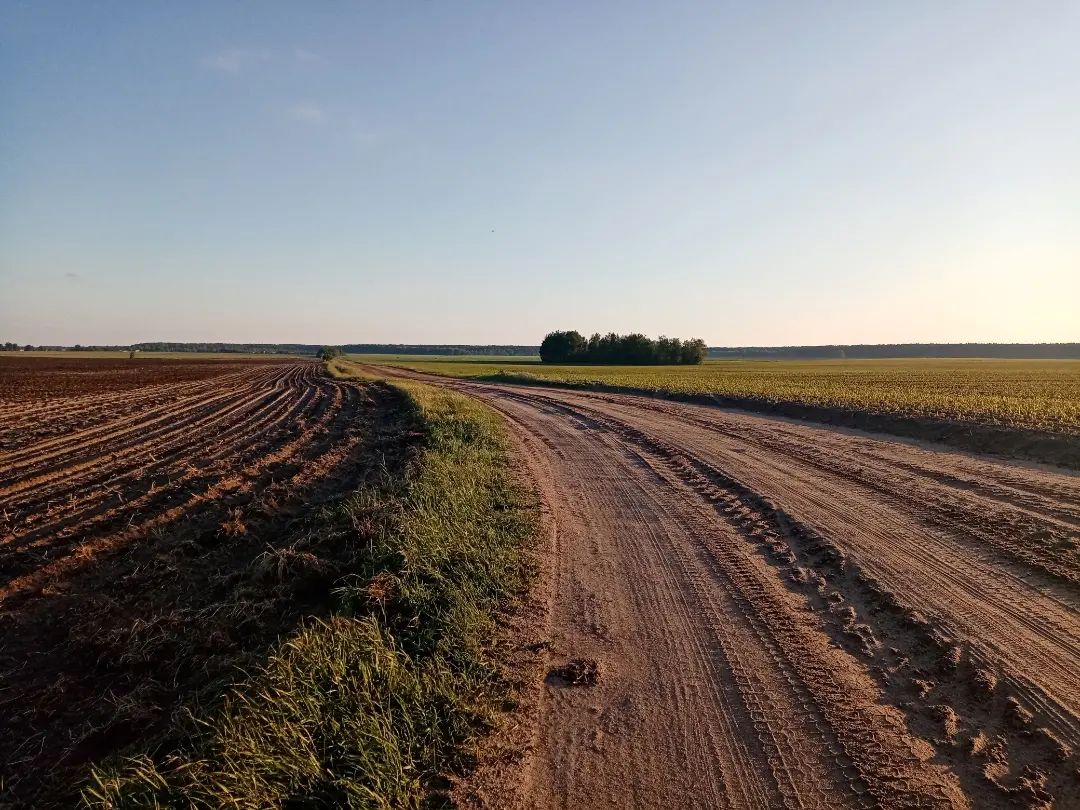
The second half of the twentieth century was a period of unprecedented hydraulic engineering expansion for Belarus. The scale of this transformation is comparable to the grandest land reclamation endeavors in the Netherlands and the Po River valley. Over four postwar decades, approximately 2.9 million hectares of waterlogged peatlands and floodplains in the BSSR were drained and brought into agricultural circulation, while the total length of open drainage canals exceeded 160,000 kilometers. This study is dedicated not merely to macroscopic acreage figures, but to a comprehensive structural examination of the entire reclamation state apparatus: from national decrees and design institutes to machinery plants, field research stations, and the formidable ecological challenges that emerged by the close of the Soviet era.
The 1945 Threshold: Devastated Drainage Networks and Postwar Recovery
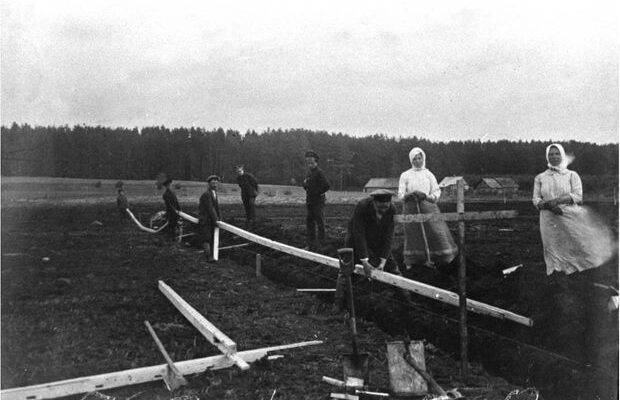
By the summer of 1944, when Belarusian territory was liberated from Nazi occupation, the regional water management infrastructure lay in ruins. Canals dating back to General I. I. Zhilinsky’s pre-revolutionary Western Expedition, the networks of the Minsk Peatland Experimental Station on Komarovka, and the prewar drainage ditches of the Oressa and Lyuban bogs had been utterly neglected during hostilities. Wooden sluice gates and bridge crossings had been burned or demolished, while river outfalls and collectors had silted over, choked with scrub, and reverted to impenetrable swamps. Tens of thousands of hectares of previously cultivated organic soils experienced secondary swamping.
Amidst catastrophic postwar food shortages, restoring the fertility of lowland peat soils became a matter of physical survival for the devastated republic. A joint decree of the Council of People’s Commissars of the BSSR and the Central Committee of the Communist Party of Byelorussia issued in February 1945 established the urgent priority of clearing trunk collectors in the river basins of the Ptich, Oressa, Sluch, Moroch, and Tsna. The early postwar five-year plans relied predominantly on manual labor: collective farm workers equipped with shovels and axes, Red Army engineer units clearing timber obstructions and defusing mines along floodplains, and horse-drawn drags used for earthmoving.
Nevertheless, the republican leadership quickly realized that restoring and expanding the hydraulic foundation purely through manual labor was untenable. The state required a specialized industrial branch governed by centralized planning, backed by heavy machinery production and supported by rigorous academic science.
Institutional Architecture: Minvodkhoz BSSR, Glavpolesievodstroy, and Regional Trusts
By the early 1960s, a unified administrative vertical for hydraulic engineering and land reclamation had crystallized in the BSSR, unprecedented among Soviet republics in terms of density and operational coordination:
1. Ministry of Melioration and Water Management of the BSSR (Minvodkhoz BSSR)
Minvodkhoz BSSR served as the operational headquarters of the industry. The ministry oversaw long-term state master plans, capital investment allocations from Moscow, regulatory technical standards, formal commissioning of new drainage systems, and inter-agency coordination with the Ministry of Agriculture and Gosplan.
2. Glavpolesievodstroy (Pinsk)
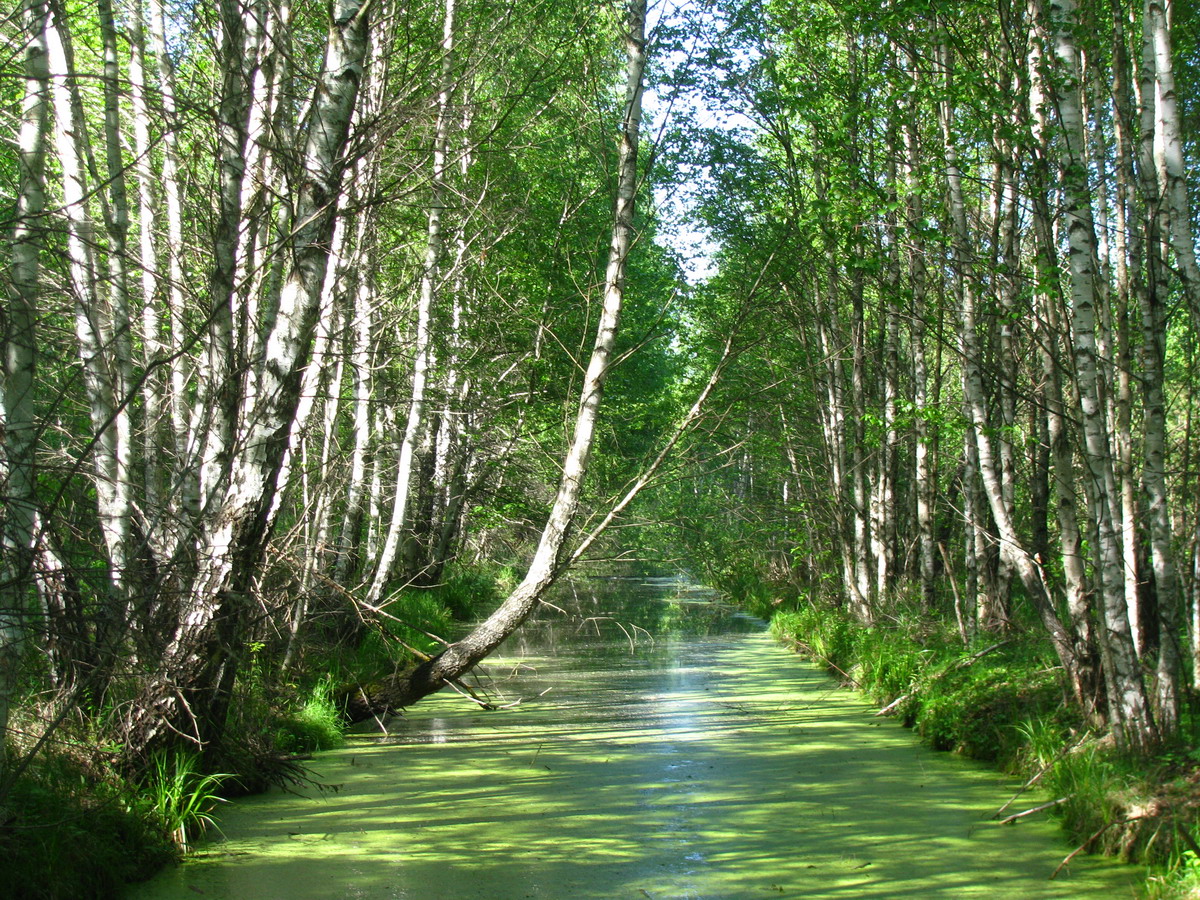
Established specifically to implement the comprehensive drainage master plan for the Polesian Lowland, the Chief Directorate for Land Reclamation and State Farm Construction in Polesia (“Glavpolesievodstroy”) was headquartered in Pinsk — the geographical and historical heart of the region. Functioning with military-like precision, this all-Union territorial directorate concentrated heavy excavators, rail spurs, ceramic tile depots, fuel reserves, and construction workers, building not only hydraulic structures, but entire state farm settlements, hard-surfaced roads, and bridges across marshlands.
3. Construction Trusts and Mobile Mechanized Columns (PMKs)
Specialized water construction trusts operated in every region: “Pinskvodstroy”, “Brestvodstroy”, “Gomelvodstroy”, “Minskvodstroy”, “Vitebskvodstroy”, and “Mogilevvodstroy”. The baseline mobile operational unit was the Mobile Mechanized Column (PMK). Each PMK possessed a dedicated fleet of dragline excavators, bulldozers, bush clearers, and mobile crew quarters, executing the entire cycle of field operations on a specific marsh tract — from scrub clearance to ceramic tile laying and canal bank profiling.
Engineering Design: Belgiprovodkhoz Institute and River Basin Regulation
No drainage project could materialize on the ground without exhaustive engineering documentation approved by state technical review. The intellectual engine of hydraulic design was the State Design Institute for Water Management Construction — “Belgiprovodkhoz” (Minsk), founded in 1951 from the Belarusian branch of the all-Union institute “Giprovodkhoz”.
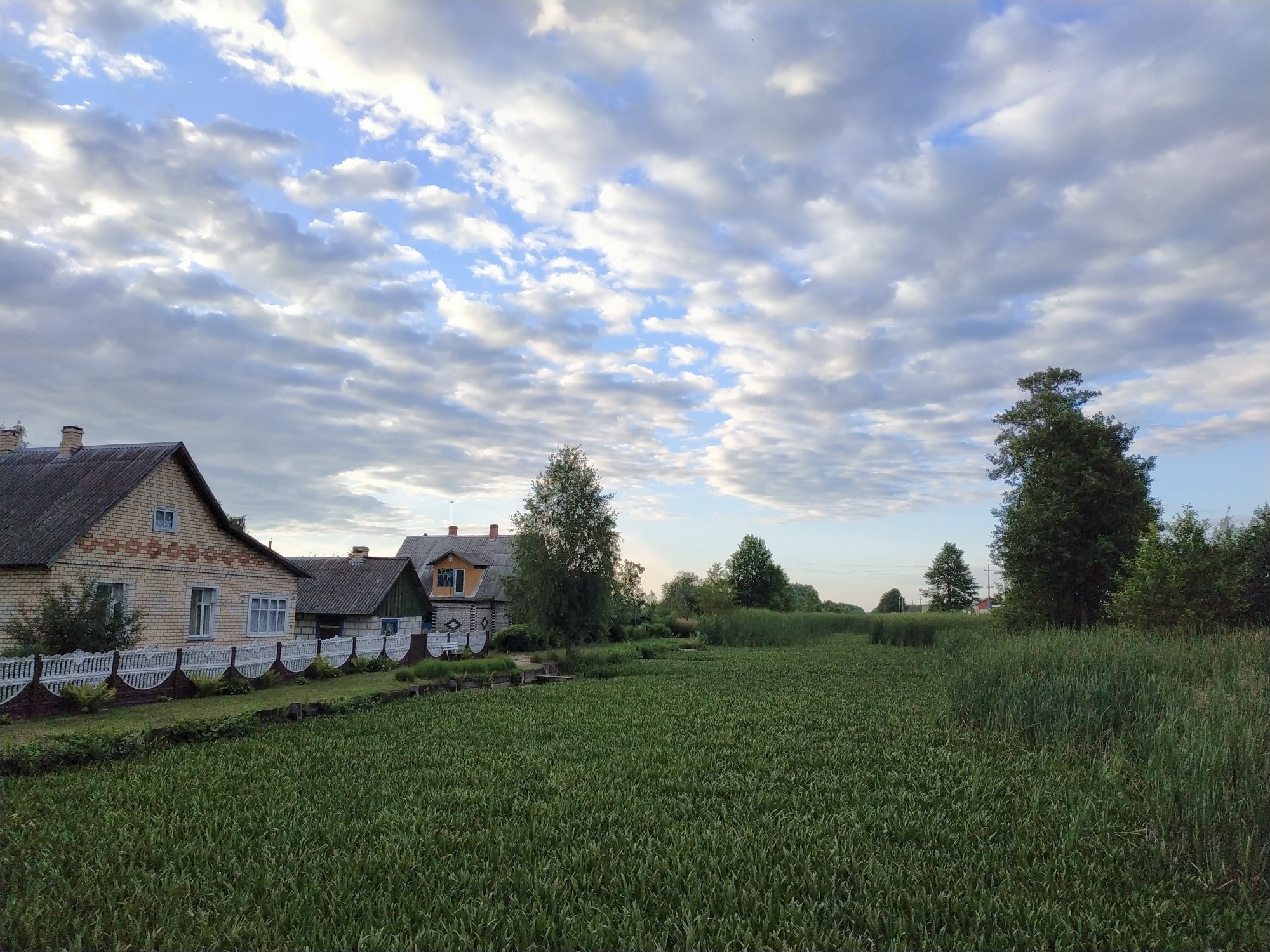
The institute comprised comprehensive technical divisions: hydraulic engineering, hydrology, engineering geology, soil and reclamation science, cost estimation, along with regional branches in Pinsk, Brest, Gomel, and Mozyr. The work of a Belgiprovodkhoz design engineer demanded sophisticated multi-factor modeling. Miscalculating river discharge capacity or canal bed gradients risked either severe bank erosion or widespread backwater inundation during spring floods.
Among Belgiprovodkhoz’s hallmark accomplishments from the 1960s to the 1980s were:
- The Master Scheme for the Comprehensive Utilization and Environmental Protection of Water and Land Resources in the Pripyat River Basin;
- Engineering design of major seasonal storage reservoirs: Soligorsk (Sluch Basin), Lyuban (Oressa Basin), Pogost (Bobrik Basin), and Selets (Yaselda Basin);
- Transition from open ditch networks to subsurface pipe drainage: designing perforated ceramic and plastic tile systems that maximized arable field area and enabled the unhindered use of wide-span agricultural machinery.
The Scientific Vanguard: BelNIIMiVH and Academician S. G. Skoropanov’s School
While Belgiprovodkhoz defined the physical geometry of canals and dikes, the biological, pedological, and agronomical essence of land reclamation was spearheaded by the Belarusian Research Institute of Melioration and Water Management (BelNIIMiVH). Tracing its lineage to the historic Minsk Peatland Experimental Station (1911) and the Institute of Melioration of the Academy of Sciences of the BSSR, it gained the status of BelNIIMiVH in 1956 (now the Institute for Land Reclamation of the National Academy of Sciences of Belarus on Maksim Bogdanovich Street in Minsk).
The institute’s golden age is inextricably linked with Academician Stepan Gordeyevich Skoropanov (1910–1999), a veteran of the Great Patriotic War who served as director of BelNIIMiVH (1948–1961), Minister of Agriculture of the BSSR (1961–1972), and Academician-Secretary of the Land Reclamation Division at VASKHNIL.
Academician Skoropanov founded an internationally recognized scientific school of peatland agronomy. The cornerstone of his philosophy was clear: peat-bog soil is not an inert sponge to be drained dry, but a living, delicate organogenic body. Skoropanov vigorously cautioned against reckless over-drainage, demonstrating that altering groundwater dynamics triggers irreversible oxidation and mineralization of organic matter — a phenomenon known as “peat burnout”.
BelNIIMiVH pioneered several fundamental research directions:
- Agromelioration and Water Table Regimes: establishing critical groundwater depth thresholds for grain crops, intertilled crops, and perennial grasses;
- Wind Erosion Mitigation: engineering shelterbelts and strip-cropping systems to shield Polesian fields against severe peat and sand dust storms;
- Peat Soil Chemistry and Microbiology: counteracting acute trace element deficiencies in copper, boron, potassium, and phosphorus on virgin peat soils;
- Specialized Forage Crop Rotations: investigating the symbiotic nitrogen fixation of legumes (clovers, alfalfa, lupines, vetch) to build resilient organic soil structures (the specific domain explored in the dissertation research of V. N. Piatnitski).
Field Research Stations: The Polesian Experimental Station and Peatland Outposts
The academic investigations of BelNIIMiVH never remained confined to urban laboratories. The institute’s greatest strength lay in its extensive network of regional experimental stations and field outposts situated in critical hydrological zones:
| Research Outpost | Geographic Location | Primary Research Focus |
|---|---|---|
| Polesian Melioration Experimental Station (POMS) | Luninets and Pinsk Districts (Tsna, Lan, and Pripyat basins) | Comprehensive agricultural reclamation of Pripyat floodplain tracts, polder meadow cultivation regimes, perennial grass mixtures, long-term cultivated pastures. |
| Lyuban Peatland Field Outpost | Lyuban District, Minsk Region (Oressa River basin) | Long-term multi-plot trials on thick lowland peat bogs, dynamics of organic soil fertility under prolonged cropping, grain and forage rotations. |
| Vasilevichi Peatland Experimental Station | Rechitsa and Kalinkovichi Districts, Gomel Region | Drainage and cultivation of mixed sand-peat tracts in Eastern Polesia, liming practices, micronutrient fertilization (copper, zinc). |
| Kopatsevichi Field Station | Soligorsk District, Minsk Region (Moroch River basin) | Hydrological balance observations, peat subsidence rates, impact of subsurface tile drainage on surrounding ecosystems. |
Scientists operated at these field stations on seasonal shifts from early spring until late autumn. Here, theoretical equations of hydrodynamics and bioclimatology were tested against reality, breeding plots for elite forage grasses were cultivated, and seasonal water-regulation regimes were perfected.
Industrial Mechanization: Wide-Track Tractors, Ditchers, and Laser Tile Trenchers
Transforming the regional landscape required machines capable of operating on soils with bearing capacities under 0.15–0.20 kg/cm², where conventional tractors sank to their chassis. Belarusian land reclamation spurred significant innovation in specialized Soviet heavy machinery:
- Swamp Tractors from MTZ and ChTZ: Minsk Tractor Works introduced crawler modifications of the MTZ series, while Chelyabinsk supplied T-100MB and T-130B tractors with wide track shoes extended to 920 mm, ensuring minimal ground pressure;
- Canal Excavators and Ditchers: The Strommashina plant in Kokhanovo (Vitebsk Region) and the Mozyr Meliorative Machinery Plant manufactured rotary ditchers, bush cutters, and continuous bucket-chain trenchers such as the ETTS-202 and ETTS-165;
- Laser-Guided Drainage Trenchers: By the 1970s, a technological breakthrough arrived in the form of trenchless and chain trenchers equipped with helium-neon laser grade-control systems. These systems automatically maintained precise pipe gradients, ensuring flawless gravity flow along ceramic and polyethylene tile lines.
The May 1966 Plenum: The Battle for Polesia and the Rise of Polder Systems
The decisive turning point that propelled Belarusian reclamation to the zenith of state investment was the May 1966 Plenum of the Central Committee of the CPSU, which launched a nationwide program of comprehensive land melioration. Substantial capital funds, machinery quotas, and building supplies flowed into the BSSR. Belarusian Polesia was designated a top-priority national construction campaign.
During this era, Belgiprovodkhoz transitioned from simple gravity drainage to the widespread construction of polder reclamation systems. Polesia presented a unique challenge: spring floods along the Pripyat and its tributaries routinely rose 2 to 4 meters above surrounding fertile lowlands, recreating the vast mythical “Sea of Herodotus”. Gravity drainage alone was completely ineffective under these conditions.
A Polesian polder functioned as an engineered hydraulic stronghold:
- Perimeter Earth Dikes: heavy enclosing dikes were erected around the tract to seal out external floodwaters;
- Internal Regulating Network: subsurface tile lines and collector canals gathered excess water into holding retention basins;
- Pumping Stations: during seasonal floods, high-capacity electric pumping stations lifted surplus water over the dikes into river channels;
- Two-Way Reversibility: during summer droughts, sluice gates were opened in reverse, drawing water back from river reservoirs to subirrigate the peat root zone.
By the late 1980s, dozens of modern polders operated across Pinsk, Luninets, Stolin, Zhitkovichi, and Petrikov districts, safeguarding over 250,000 hectares of high-yield meadows and arable land.
The Ecological Dilemma: Peat Subsidence, Dust Storms, and Two-Way Regulation
This hydraulic triumph carried severe ecological consequences. By the mid-1970s, unrelenting target quotas for drained acreage collided directly with ecological limits:
- Peat Mineralization and Subsidence: aeration and constant cultivation caused rapid biological decomposition of organic matter. Peat layers subsided at rates of 1 to 2.5 centimeters annually. On shallow bogs under one meter deep, the entire organic horizon disappeared within two to three decades, exposing barren podzolic sands;
- Polesian Dust Storms: in the dry springs of 1969, 1974, and 1979, severe black dust storms swept across Polesia. Desiccated, pulverized peat was lifted hundreds of meters into the atmosphere, choking canals and burying crops;
- Disruption of the Hydrological Balance: channelizing small rivers and draining wetland sponges lowered water tables in adjacent pine forests, depleted village wells, and reduced low-water river discharges.
Academician S. G. Skoropanov and BelNIIMiVH scientists took a firm, courageous stand against industrial ministries. They advocated prohibiting row crops (potatoes, sugar beets) on vulnerable peatlands, demanding permanent grass sod establishment and the mandatory implementation of two-way moisture regulation.
This scientific resistance gave birth to modern Belarusian hydro-ecology. The government approved strict conservation measures for intact mires, establishing premier wetland reserves (“Sporovsky”, “Zvanets”, “Dikoje”), while shifting state priorities toward ecological optimization of existing networks.
The Chernobyl Frontier (1986): Emergency Hydraulic Countermeasures and Radiation Defense
The catastrophic accident at the Chernobyl Nuclear Power Plant on April 26, 1986, presented the Belarusian land reclamation system with an existential crisis. Radioactive fallout blanketed the basins of the Pripyat, Sozh, Iput, and Besed rivers, contaminating thousands of kilometers of drainage canals across Bragin, Khoiniki, Narovlya, Chechersk, Krasnopolye, Vetka, and Dobrush districts.
An acute threat emerged: heavy precipitation and spring runoff threatened to flush radiocesium, strontium-90, and plutonium from drained peatlands through open canals into the Pripyat, the Kiev Reservoir, and the Dnieper River system, jeopardizing the drinking water supply of tens of millions of people downstream.
Within weeks of the explosion, Belgiprovodkhoz engineers and regional mechanized columns entered the 30-kilometer exclusion zone. Operating in high-radiation fields, reclamation teams executed vital defensive works:
- Constructing dozens of filtering retention dams equipped with zeolite and mineral sorption barriers across drainage collectors;
- Sealing and decommissioning canal outlets across the Braginka and Nesvich catchments;
- Excavating interceptor bypass channels to divert clean runoff away from highly contaminated radiation hotspots.
Simultaneously, BelNIIMiVH launched field radiological research on organic soils. Discovering that peat binds radionuclides differently from mineral soils, researchers formulated specialized potassium-lime-phosphorus regimes that reduced radiocesium uptake in fodder crops and dairy products by five- to eightfold.
Historical Lessons and Archival Heritage (BGANTD)
The era of Belarusian land reclamation (1945–1990s) left behind a complex, multifaceted legacy. It was a period of extraordinary dedication by engineers, scientists, machine operators, and agronomists who rebuilt the agrarian economy of the republic and eliminated endemic malaria and bog isolation. Yet it also delivered an enduring ecological lesson: nature does not forgive the disruption of its fundamental hydrological equilibrium.
Today, the principal repository preserving the documentary memory of this epic transformation is the Belarusian State Archive of Scientific and Technical Documentation (BGANTD) in Minsk:
- Fond 32 (BelNIIMiVH): Academic Council minutes, departmental field reports, observation journals from Polesian, Lyuban, and Vasilevichi stations, and dissertation records of the Skoropanov school;
- Fond 57 (State Design Institute “Belgiprovodkhoz”): Master drainage schemes of Polesia, blueprint folios of polder installations, river regulation projects for the Pripyat, Ptich, and Oressa, and reservoir design documentation;
- Fond 63 (Glavpolesievodstroy, USSR Minvodkhoz): Production records of regional construction trusts, equipment allocation directives, and chronicles of state farm development in the Polesian Lowland.
Sources and References
- Skoropanov S. G. Land Melioration and Environmental Protection. — Minsk: Uradzhay, 1982. — 175 p. (In Russian).
- Skoropanov S. G. Reclamation and Utilization of Peat-Bog Soils. — Minsk: Publishing House of the Academy of Sciences of the BSSR, 1961. — 250 p. (In Russian).
- Institute for Land Reclamation of the National Academy of Sciences of Belarus: Historical Essay and Modernity / Ed. by Academician N. K. Vakhonin. — Minsk: Belaruskaya Navuka, 2021. — 312 p. (In Russian).
- Pechkurov A. F. Channel Stability of Rivers and Canals in Hydraulic Construction of the BSSR. — Minsk: ASKhN BSSR Publishing House, 1959. — 188 p. (In Russian).
- Handbook of Melioration and Water Management / Ed. by B. S. Maslov. — Moscow: Agropromizdat, 1985. — Vols. 1–3. (In Russian).
- Brey G. V., Kozlovsky I. V. Water Management in Byelorussia: Pages of History. — Minsk: Polymya, 1988. — 144 p. (In Russian).
- Vakhonin N. K. History and Scientific Foundations of Land Melioration in Polesia // Melioratsiya. — 2016. — No. 2 (76). — Pp. 5–14. (In Russian).
- Shkutov E. N. Polder Systems of Belarusian Polesia: Hydrological Aspects and Operating Experience. — Minsk: Uradzhay, 1993. — 216 p. (In Russian).
- Belarusian State Archive of Scientific and Technical Documentation (BGANTD). — Fond 32 (BelNIIMiVH), Fond 57 (Belgiprovodkhoz), Fond 63 (Glavpolesievodstroy).